Thursday, 16 January 2020

Bucket developing Kodak Vision3 colour movie 16mm film. 2 fails & a "success"

This is supposed to be a blog about 9.5 mm adventures but there will always be room here for other formats and experiments.
I bought this super c1933 Kinecam 6 camera  - which takes 16mm film  - a few months back, and I've had some success shooting B&W film and bucket developing it.


Last week I tried colour film developing for the first time with 20 feet from a large roll of movie film, Kodak Vision3. It doesn't say when it expired but I'm hoping the 08 sticker means it's 'only' 12 years out of date. At £20 postage free, for 400 feet, this is an absolute bargain, if I can get decent results from it, which as you will see below, I haven't so far...


Using the Tetenal C41 Kit at the alternative temperature of 30 degrees rather than 38 degrees, I got this result, using bucket development. Fail!


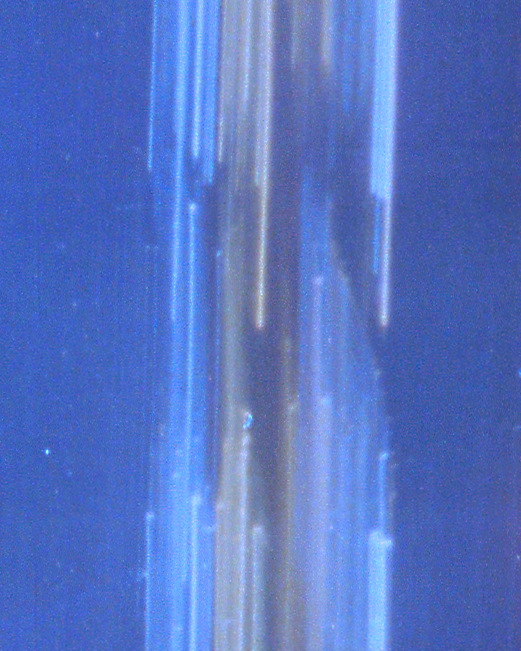
The negatives were extremely thin, and with a heavy blue cast, and worst of all, everything was blurred. The main problem is that the claw hadn't engaged with the film so every frame was streaked like this.

Some more research on the Vision 3 film revealed that standard C-41 processing is suboptimal at best, and disastrous at worst, as it's supposed to be developed using ECN-2 chemistry. The Eastman Colour Negative (ECN) process is the standard development method for all modern motion picture colour negative developing. Using C-41 can lead to thin negatives, unpredictable results and strange colour casts.

You can buy ECN-2 kits online but they are expensive for the small quantities I need, but RA4 chemistry can be used as a substitute, so I've ordered some of that to test out. Another suggestion is that Vision3 must be developed at the right temperature if you use C41, presumably that's 38 degrees, not the alternative 30 degrees.

Also, it's designed for indoor filming (T for Tungsten) so you need a filter for outdoor filming otherwise everything will be blue.
I got an 85B filter, held it in front of the lens and shot a few feet of some glass ornaments with the sun illuminating them from behind against the blue sky


then developed the film in C-41 at 38 degrees.

Result: fail again! The claw still wasn't engaging properly so everything is smeared. But the filter has helped with the colour cast, and although the negatives are still very thin, it's an improvement, of sorts:


And a close crop suggests the film is not too grainy:

For one filming session the claw actually engaged properly with the film, and using the 85B filter (but 30 degree development) there is a film to share! It's thin again, and it has lots of weird colour shifts, but hopefully this will be addressed by changing to RA4 chemistry next time, and developing at 38 degrees.

And on a positive note, I adapted a 1930s Mickey Mouse projector and it worked really well for the telecine:


Here are a couple of frames from it:


And here's the final video of the result. Only some very short sections could be saved in the telecine as some areas were too thin, so each clip is repeated to make it last.

Well it's a start, and things can only get better, as they say.


Sunday, 12 January 2020

Christmas Day testing with Pathe Baby cameras

Another short test result for my Christmas day experiments with hand cranked c1923 Pathe Baby camera, and also a brief clip at the end, shot with a different Pathe Baby with the camo motordrive attachment:


Again developed in Perceptol stock solution and overexposure with the filming, and also overexposure with the digital capture in the telecine process, (corrected later to normal levels) to reduce the appearance of grain in the long expired Ferrania film.
Shot with the standard lenses and using the 1m and 0.5m push on lenses from a Pathe B.

The video link is below, but here are some single frames which better show the quality of the film before youtube compression. These frames of my nephews were shot with the 0.5m push on. The aperture was wide open on both cameras due to the very weak winter sun. Nice results considering sub-optimal conditions!

George:


And Jack:


And the video:

Saturday, 4 January 2020

Cutting and perforating my own 9.5mm film using 16mm stock

For many years I've dreamed of being able to make my own 9.5mm film, as it's no longer produced anywhere in the world.  Als many years ago I bought a DIY hand crank music box. They come with a tiny punch which makes holes in the paper strips so you can make your own tune;


The punch cuts lovely holes in film:


But this makes round holes whereas 9.5mm film needs a rectangular sprocket hole of a very specific size and shape.

Or does it??
The punch is roughly the right width so maybe it would work, and it costs nothing to find out. I cut down some old strips of 16mm double perf, just roughly measured by eye:


then punched holes in the film, again just measuring roughly using the lines on the pad as a guide:


The punch did the job and the result looked lovely:


But could it possibly work in a camera?

I tried it in 3 different models, a c1923 hand cranked Pathe Baby, a c1933 motor driven Cine Nizo Model F, and a 1959 Prince. It worked perfectly in all three! And it also worked with the single shot function in the Prince.

I'm hoping the claw is catching the film consistently in the same place between the sprocket hole each time, and that it's roughly central to the hole so the frame isn't shifted up or down. Maybe this wouldn't work in a projector, but at the moment I just want to be able to use these wonderful old cameras with colour film, and I can telecine the results.

The next job is to automate the process a little more; at one punch every 5 seconds, I won't be going into commercial production any time soon...

Here's the video showing the 3 cameras, 2 clips repeated for clarity, and the single shot function at the end. Exciting times!


Monday, 23 December 2019

First light with French made, Camex Ercsam GS 9.5mm camera c1947

You know as soon as you hold it, that this is a quality camera, and it becomes even more apparent when you look at the features, including 4 speeds, single shot and focusing down to 0.5m. And when you turn on the clockwork motor it purrs beautifully.
 It hadn't been used with film for many decades, but after a clean up it shone like new and was ready for a test:


The charger is unique to the Ercsam, and has a very clever design feature, which is that the back pressure plate is built into it:


I loaded about 12 feet of the expired Ferrania negative film into it and shot it in Old Hatfield, Hertfordshire.  

Developing, as usual, was done in a bucket of stock strength Perceptol, for 9 minutes + 10% as it was the second use of the developer.  
There was the weakest of winter sunshine, which mostly disappeared behind haze and cloud, but the lens is very fast, a Cinor C, f/1.9, so the 6 ASA film was just usable with the 1/32nd of a second shutter, and a fully open aperture. 
The first section, showing the pub, was shot at 32 frames per second, another section ( I forget which...) at 8th second, and the rest at standard 1/16th second. 

The final "talking head" test is me holding the camera at arm's length. I set the focus at its closest point, and luckily it turns out my arm is exactly 0.5m long so the focus is spot on. Everything  looks sharp, and this was with the most challenging of light conditions, so it will be interesting to see how it performs on a brighter day with smaller apertures. 

I did 2 versions of the Telecine, one more exposed than the other. The difference between the 2 is remarkable. The top part (with inverted and original frame) was exposed for a longer time when photographing with the DSLR in the telecine, the bottom part is the same frame, but exposed for less time. The cropped sections next to the frames show that the longer exposure gives a far sharper final image. I'm not really sure why:


The only small issue is that the camera stops working if you take more than 2 consecutive single shots. Again, I don't know why, but popping open the camera and moving the charger resets everything back to normal .
The video:


Thursday, 19 December 2019

Results from developing 1940s (?) film in sealed P Charger, Part 1

I bought this sealed charger off Etsy this week. The seller obviously had no idea of age or condition of the film inside, but I thought it was such an exciting idea to try to develop whatever was in it that I took a chance at £20 +£2 postage.


It's a P style charger, and I read that these were introduced in 1927 and superseded by the H charger in 1937. The film could be much later than that of course, but it could easily be from, say, the 1940s.
It was very hard to open it, (yes, in the dark ;-) even after the seal was broken and inside was a very full chamber of film. In fact it was so packed with film it was difficult to actually get any out.  I clipped off 2 sections and developed one in stock Perceptol and the other in coffee (Caffenol C-M) with iodised salt to address fogging. I've had success developing glass plates from the 1920s in coffee so it seemed a  good place to start.

The results: oh dear.  I try to be brave but  little bit of me when I pull out a failed piece of film from the fixer.

The Perceptol clip had no sign of any images, just blotchy thick dark fog. The Caffenol clip looked the same, but looking closer, there seemed to be vague shapes in some areas, so I developed another section, and this time there are faint images to be seen.  I don't know if it's negative film which would be turned positive during development, or reversal film but here it is reversed:


I'll be experimenting further with different developers and methods but it seems reasonable to hope there are better images to be had from this. It would be a cruel trick of the Universe if these few frames are the best from 50+ feet!

I'll update here as improved results appear, but for now here's the best frame of the lot. Intriguing...


Tuesday, 10 December 2019

Cine Nizo Model F camera

I now have my Cine Nizo Model F camera and can't wait to try it with film.
The seller bought if for display in Germany in the 1980s  so goodness knows when it last was used with film. I believe these were produced stating in 1929.
According to Grahame Newman's site
"The company Neizoldi & Kramer was founded in Germany around 1925; from then till the late 1930s.
Little of this early cine equipment arrived in the UK. But we do see that a UK distributor, Peeling & Van Neck Ltd of 4/6 Holborn Circus, London, E.C.1 began importing some of the Cine Nizo cine equipment in the 1930s. [An advert] shows that certainly models 'F'; 'K' and 'M' of their 9.5mm cine cameras were certainly available in the UK. Prices were rather high compared to 9.5mm cine cameras from companies like Coronet, Dekko and Pathéscope meaning UK Cine Nizo sales must have been quite low."
I'm told it's a very rare camera to find in the UK.


The claw mechanism is lovely: Video here:


Saturday, 7 December 2019